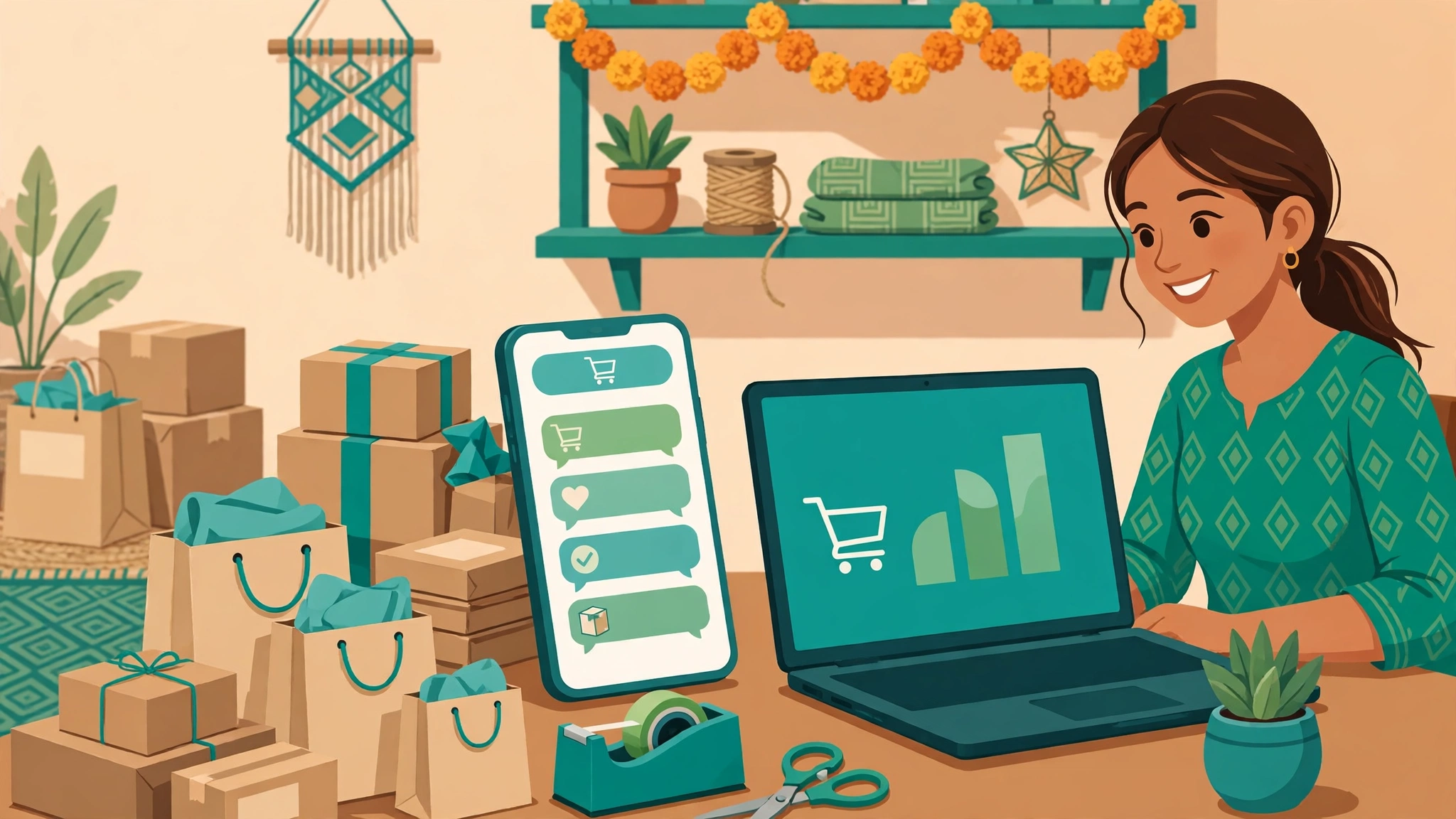
She added a kurti, a serum and a pair of earrings to the cart. Got all the way to the payment page. And then — nothing. No order. No message. Just a cart sitting there, full, abandoned.
If you run a D2C store in India, you already know this scene. It plays out dozens of times a day. Roughly 7 out of 10 carts are abandoned, and the email you send afterwards? Opened by a fraction of those shoppers. The cart isn't lost because your product is wrong. It's lost because the follow-up never reached her at the right moment, on the app she actually opens.
And that app, for most Indian shoppers, is WhatsApp. She checks it 20-plus times a day, and a recovery message there lands on her lock screen within minutes, can be replied to, and can carry the exact product image she was staring at. Done right, abandoned cart recovery on WhatsApp turns silent drop-offs into completed orders. No discounts on every cart, no spamming anyone — just the right nudge at the right hour.
Why the email never stood a chance
When did you last open your promotional email tab? Exactly. Email recovery was built for a world where people checked their inbox. Indian shoppers don't live there anymore.
Published D2C recovery guides report WhatsApp open rates around 98% against 5–8% for cart-recovery email in India, and recovery rates of 15–25% on WhatsApp versus 2–5% on email. Treat those numbers as directional, not guaranteed — your own rate depends on your opt-in list, your prices and your product. But the gap is consistent across every Indian D2C write-up on the topic: a WhatsApp message arrives on the lock screen, while an email waits in a tab nobody opens.
India adds three wrinkles that make WhatsApp even more valuable, and if you sell here you already know all three by heart. COD, for one. Plenty of shoppers abandon because they're unsure about cash on delivery, or because COD wasn't prominent at checkout — and a chat message can confirm COD in one tap. Then UPI failures. A failed UPI payment is the most fixable abandonment reason there is, and a payment link sent on WhatsApp closes it in seconds. And then there's plain old distraction. Mobile-first shoppers get interrupted mid-checkout by a call or a family message and simply forget. A gentle reminder within the hour catches them while the intent is still warm.
Before you send anything, protect the number
Here's the part people skip, and it's the part that can quietly kill the whole channel. Your WhatsApp number is an asset. Treat it like one.
Cart recovery runs on the official WhatsApp Business API, not the free Business app, and Meta enforces three rules. Break them and your number's quality rating drops — which limits how many messages you can send per day.
First, opt-in is mandatory — you may only send recovery templates to shoppers who agreed to hear from your business on WhatsApp. Add a clear opt-in checkbox at checkout — "Get order updates and offers on WhatsApp" — and watch your eligible audience climb. Buying lists or messaging numbers that never opted in will get your number flagged fast.
Second, templates must be approved by Meta — outside a 24-hour customer service window, you can only send pre-approved template messages, and approval usually takes minutes to a day, so build your template library before a sale weekend, not during it.
Third, three messages is the practical ceiling — more than three per abandoned cart drives complaints and blocks.
Cost is small but real, and it's worth knowing before you start. From 1 October 2026, Meta's list rate in India is ₹0.8631 per delivered marketing template message and ₹0.1150 for utility templates, plus 18% GST, with 1,000 free service messages per number per month. Your provider adds its own fee on top. At those rates, recovering even one ₹999 order pays for hundreds of messages — which is why recovery is usually the highest-ROI automation a small store runs.
Follow one shopper through the day
Forget the flowchart for a minute. Follow her instead.
She abandons the cart at, say, 2 pm. 30–60 minutes later — while she's still near her phone, while the kurti is still in her head — a gentle reminder arrives. No discount. No pressure. Just the actual products, the product image, and a link straight back to the saved cart. Not your homepage. The saved cart. A shopper who has to re-find her items will not bother.
Something like this, in her language: "Hi [Name], aapka cart save hai! Aapne [Product 1] aur [Product 2] chhoda tha. Yahan se checkout continue karein: [Cart link]" If your store serves Hindi/Hinglish shoppers, a Hinglish template will outperform stiff English; premium stores, keep it English but just as short. The goal of message one is a tap, not a sale. The sale follows the tap.
Now suppose she doesn't tap. A day passes. By now she probably has a question, or a doubt, and that's the real reason she stalled. Is COD available? Is this returnable? Is the size true to chart? So the next morning, message two answers the most common objection for that product category — and invites a reply. A reply opens a 24-hour customer service window, inside which you, or your chatbot, can chat freely.
Try: "Still thinking about [Product]? COD available hai, 7-day easy returns ke saath. Koi question ho to yahan reply karein — hum turant jawab denge. Aapka cart: [Cart link]" This is where an AI chatbot for business earns its keep — a shopper asking "is this fragrance-free?" at 11 pm gets an instant answer instead of waiting till morning. And published case notes from Indian D2C setups report that a meaningful share of recovered carts — around one in five in one Delhi apparel example — came from shoppers who first replied to message two with a question. The reply is the whole point.
48–72 hours in, and only now — only for the shoppers who opened message one or two without buying — should a discount appear. Sending a coupon in message one trains customers to abandon carts on purpose and wait for the code. Reserve the offer for message three, give it a hard expiry, and use a personal code.
"Last reminder from us, [Name]. Aapke cart par 10% off — code CART10, sirf 24 hours ke liye valid. Checkout karein: [Cart link]" Cap the discount at 10% for most categories; if your margin can't carry 10%, offer free shipping instead — for low-value carts it often converts better than a percentage off.
But wait — not every cart follows that path, and the two detours matter just as much. A large share of Indian abandonment is COD hesitation — the shopper picked COD, then worried about paying at the door, or picked prepaid and then wanted COD. When a cart contains a COD-eligible order, send a confirmation flow instead of a discount flow. Message one asks the shopper to tap Confirm or Cancel for their COD order. This single step also cuts return-to-origin losses, because a shopper who confirms is far less likely to refuse delivery. If they tap Cancel, stop the flow and offer prepaid with a small incentive instead of chasing a dead order.
And then the easiest win of all, the one most stores miss entirely: UPI failures, card declines, session timeouts. These are the easiest carts to recover because the shopper wanted to pay. Trigger this flow within 15 minutes of a payment failing, not an hour later: send a fresh payment link on WhatsApp with UPI as the default option, and keep the cart intact. One short message — "Payment fail ho gaya? Koi baat nahi, is link se dobara try karein (UPI/COD available)" — recovers orders that a generic reminder sent the next day never would. This flow should run alongside the others, not instead of them, and it must never carry a discount. The customer already decided to buy.
How do you know it's working?
Start with the recovery rate — recovered orders divided by abandoned carts messaged; Indian D2C guides report 15–25% as a realistic range. Then revenue per 1,000 messages: recovered revenue divided by messages sent, which tells you whether message three's discount is earning its keep or just eating margin.
Watch the opt-out and block rate too — if blocks rise above a fraction of a percent, cut message three first. And the reply rate on message two: replies are gold, every answered reply is a conversation your competitors are not having.
Run the sequence for 30 days before judging it — the first week mostly tells you whether templates got approved and the opt-in checkbox is working; the recovery rate stabilises in weeks three and four. Give it a month.
The mistakes I keep seeing
Sending the discount in message one is the classic error. The others are quieter, and they bleed revenue without anyone noticing.
Linking to the homepage instead of the saved cart. One generic template for a ₹299 item and a ₹4,999 item, as if the same words fit both. Recovery on a number that also blasts daily broadcasts, so customers mute you. And — the most common in India — collecting phone numbers at checkout without a WhatsApp opt-in, then wondering why half your carts are ineligible. Fix the opt-in first; the flows are useless without an audience.
Compared with email, WhatsApp recovery is a conversation channel, not a broadcast channel. Our earlier comparison of WhatsApp vs email marketing makes the same point: the channel that lets the customer reply wins, because the reply is where objections get answered and sales get closed.
Start this week, not next quarter
You do not need a big build. Connect the WhatsApp Business API through a provider, add the opt-in checkbox at checkout, get three templates approved, wire the cart-abandonment webhook from Shopify or WooCommerce, and launch the gentle reminder and the payment-failure rescue first — they recover the most revenue with the least discounting. Add the objection handler in week two, the discount close once you can see who is engaging.
If you'd rather have it built for you, WebCrafts Technology's WhatsApp automation services cover API setup, template approval, chatbot fallback and CRM integration, so recovery runs on its own while your team handles the conversations that reply back.
For a deeper walkthrough of real D2C recovery sequences and timing tests, see Cunnekt's guide to WhatsApp cart recovery for D2C brands. For the current API rules, messaging limits and India pricing behind the compliance section above, see Automate AI's 2026 guide to the WhatsApp Business API in India.
Frequently Asked Questions
What is WhatsApp abandoned cart recovery?
It is an automated sequence of WhatsApp messages sent to shoppers who added items to their cart but left without buying. The messages remind them of the exact products, link back to the saved cart, answer objections and — only at the end — offer an incentive. Because WhatsApp messages are opened far more often than email, recovery rates of 15–25% are realistic for Indian D2C stores.
Do I need customer opt-in before sending cart recovery messages?
Yes. Under Meta's rules you may only send template messages to shoppers who agreed to receive WhatsApp messages from your business. Add a clear opt-in checkbox at checkout, such as "Get order updates and offers on WhatsApp". Messaging numbers without opt-in risks a quality-rating drop and limits on your number.
When should I send the first WhatsApp cart recovery message?
Within 30 to 60 minutes of abandonment, while purchase intent is still warm. A gentle, discount-free reminder with the product list and a direct cart link performs best at this stage. Payment-failure rescues should go even faster — within 15 minutes — with a fresh payment link.
How many recovery messages should I send?
Three is the practical ceiling per abandoned cart: a gentle reminder, an objection-handling follow-up at 24 hours, and a discount close at 48–72 hours for shoppers who engaged but did not buy. More messages drive complaints and blocks, which lower your number's quality rating.
How much does WhatsApp cart recovery cost in India?
From 1 October 2026, Meta charges ₹0.8631 per delivered marketing template message and ₹0.1150 for utility templates, plus 18% GST, with 1,000 free service messages per number per month. Your provider adds its own fee. Recovering even one mid-value order typically pays for hundreds of messages.