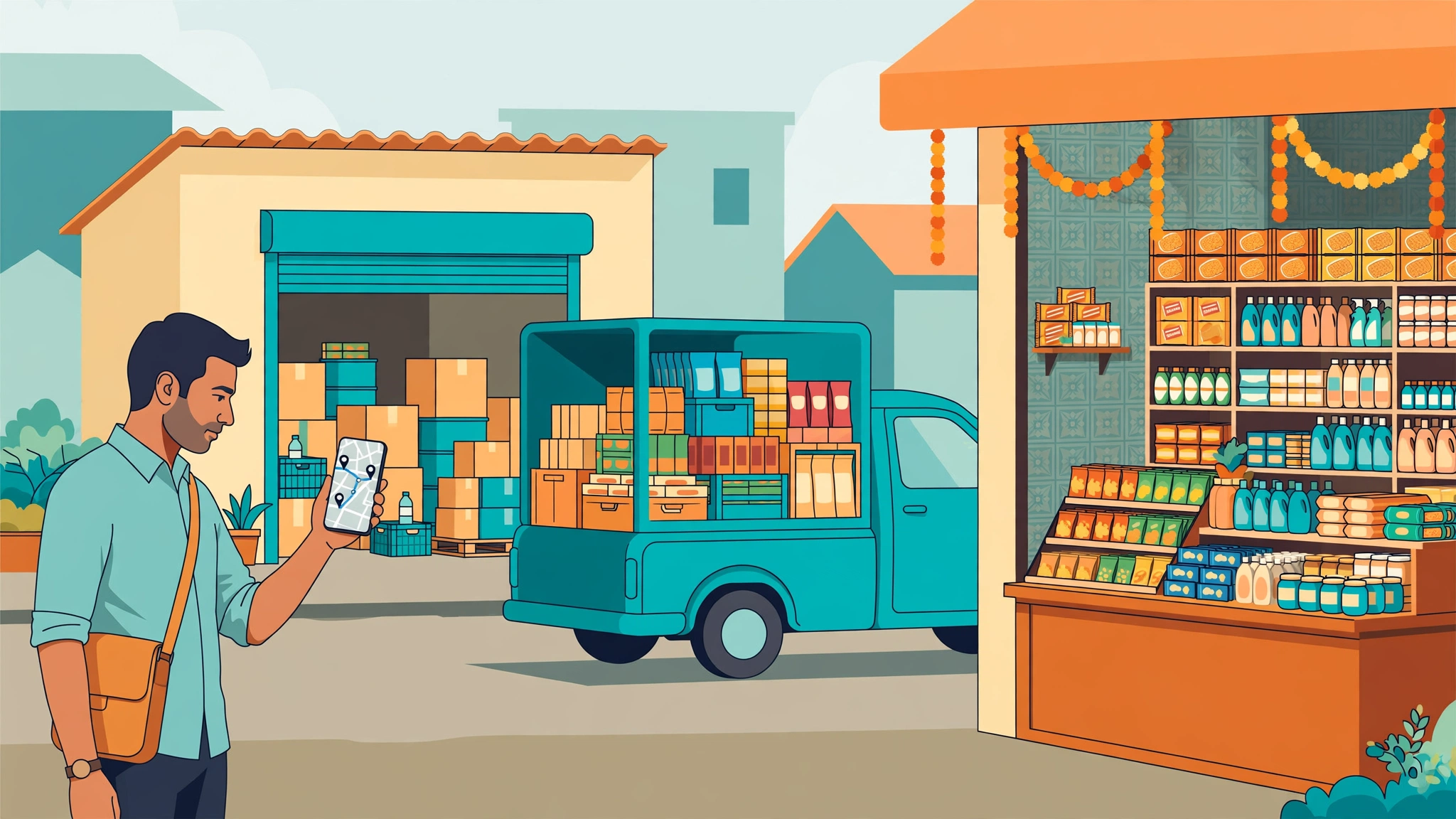
If you run FMCG distribution in India, you already know the weirdest part of the job. You can tell anyone, to the rupee, how much stock you bought from the company this month. Ask how much actually reached a kirana shelf — which shop, which SKU, on which day — and the answer turns into a shrug and a salesman saying "sir, sab ho gaya." That's the gap distribution management software exists to close: not the billing, the visibility after the billing.
India's FMCG market was worth about US$ 289 billion in 2025 and is projected to reach nearly US$ 643 billion by 2030, according to IBEF's FMCG industry overview. Rural India already accounts for more than 38% of FMCG sales — which means more distributors, more beats, and more places where stock quietly disappears from view. If your channel still runs on WhatsApp photos of order books and a Tally file only the accountant understands, the market is outgrowing your systems.
This guide is for first-time buyers — distributors, and the smaller FMCG brands who sell through them — on what distribution management software in India actually does, what it should cost, and how to pick one without buying a system built for a company ten times your size.
What distribution management software actually is
Strip away the sales decks and a DMS does one job: it records, in real time, every movement of goods and money between the brand, the distributor, and the retailer. Three layers usually sit inside it, and vendors mix them up on purpose — get the vocabulary straight before any demo.
Distribution management (DMS) is the distributor-side core: godown stock, orders, invoicing, schemes, claims, credit, and the reports your principal asks for every month. Sales force automation (SFA) is the field layer: beat plans, GPS check-ins, order booking on a salesman's phone, van sales. Billing/accounting is the money layer: GST invoices, e-way bills, ledgers, GSTR returns. A good system ties all three together, so an order booked at a kirana at 11 am shows up in the godown stock, the retailer's ledger, and the principal's secondary-sales report without anyone retyping it.
Here's the test I use: if the tool can't tell you what happened after the invoice, it's an order-entry app wearing a DMS badge. Every billing software prints a GST invoice. The hard part is the secondary sale — that's where the money is made or lost.
Primary, secondary, tertiary: the three sales that run your business
Every FMCG channel runs on three sales, not one, and most small distributors only track the first.
- Primary sales — the brand sells to you, the distributor. Stock lands in your godown, you book it in Tally or Busy. Fully visible. This is the number your principal celebrates and your bank looks at.
- Secondary sales — your salesmen sell that stock to retailers along fixed routes. This is real demand: which outlet bought which SKU, at what price, with which scheme. If you can't see this, you're guessing.
- Tertiary sales — the retailer sells to the shopper. Mostly inferred from how fast the retailer reorders.
The trap is managing the business on primary sales alone: primary tells you how much you pushed into the channel, not how much pulled through. When primary grows but secondary stalls, you're stuffing the channel — and you'll find out three months later as expiry returns and credit notes. A proper DMS makes that gap visible every day, SKU by SKU. Our guide on secondary sales tracking software goes deeper — the one module I'd never buy a DMS without.
The 7 modules that actually matter
Every vendor will show you twenty features. These seven decide whether the software earns its keep.
1. Order capture on a beat plan
A beat is the salesman's route — the fixed list of outlets he visits on a given day of the week. The software should hand him his daily beat on a phone app, record the order at every outlet (SKU, quantity, scheme applied), and — the part most tools skip — record the no-order and not-visited outlets too. Coverage becomes a number: planned vs visited vs billed, per beat, per salesman, per day. If he claims 60 shops and the app shows 41 check-ins, that's a conversation worth having. Check two things in a demo: GPS check-ins with geo-fencing, so a shop only counts if the salesman was actually there — and offline mode, because beats run in low-connectivity markets.
2. Secondary sales tracking at retailer level
The heart of the system. Every retailer invoice the DMS generates is automatically secondary-sales data — by brand, SKU, beat, and retailer. Roll it up and you see true sell-through. Dead SKUs surface in weeks, not quarters, and fast movers going out of stock get flagged before the retailer switches to a competitor's brand.
3. Van sales (ready-stock selling)
In much of rural and semi-urban India, order-today-deliver-tomorrow doesn't work — the shop wants stock now. Van sales means the salesman travels with inventory and sells on the spot, so the software must handle load-out, on-van stock, per-outlet billing, and end-of-day reconciliation. A vendor that can't do proper van sales has no business selling to Indian distributors.
4. Distributor stock, batch and expiry
Your godown is your real inventory position in the market. Good software syncs stock in near-real time, flags ageing and near-expiry lots, manages damage and expiry returns, and reconciles your purchases (primary) against your sales (secondary) so overstock can't hide. FEFO — first-expiry-first-out — is the difference between rotating stock and writing it off. Busy Software's distributor guide notes the near-expiry report is often the fastest payback of the whole implementation — distributors typically recover more in avoided write-offs in year one than the software costs.
5. Schemes and claims
FMCG runs on trade schemes — buy-10-get-1, slab discounts, price-offs, display incentives — and they change constantly. The software must apply the right scheme automatically at billing, so the salesman can't fat-finger it, and reconcile the claim when you ask the brand to reimburse the scheme cost. Manual scheme-claim reconciliation is one of the biggest sources of leakage and distributor disputes in Indian FMCG, and every claim needs invoice-level backing — or the principal's accounts team rejects it and you eat the loss.
6. Credit, outstanding and collections
Distribution is a working-capital business. The system should show each retailer's outstanding and credit limit at the point of ordering, block or flag over-limit orders, and age receivables so you know who owes what since when. Collections stay linked to the shop, the salesman, and the route — so the morning meeting stops being "kisi ko pata hai Sharma General Store ka payment aaya?" and starts being a list.
7. GST compliance and principal reporting
E-invoice and e-way bill from the invoice screen, GSTR-1 and 3B from the books, 2A/2B reconciliation against principal invoices. And the monthly principal report — primary and secondary sales, closing stock, scheme utilisation — as a scheduled export in the layout the principal asks for, instead of a two-day Excel assembly job at month end. If you're still building principal reports by hand, this module alone pays for the software.
What does distribution management software cost in India?
Honest answer: it depends which side of the counter you're buying for — and vendors rarely publish prices, which is itself useful information.
Most FMCG SFA and DMS products are priced per field user per month. Entry-level tools commonly run a few hundred rupees per user per month. Mid-market platforms cost more — one vendor, BeatRoute, publicly lists roughly ₹700 to ₹1,470 per user per month, a usable market anchor from a detailed DMS buyer's guide for FMCG in India. Enterprise suites are quote-only; distributor-side systems are often licensed per location instead of per user.
Price the full rollout, not the per-seat rate. Onboarding, data import, beat setup, scheme configuration, and training your field team — that's where the real cost and risk sit. A vendor quoting ₹500/user/month who takes six weeks to go live costs more than one quoting ₹900 who goes live in two. And ask, in writing, what happens to your data if you cancel. If the answer is vague, walk away.
How to choose: a 6-question checklist for first-time buyers
Run every shortlisted vendor through these before you sign anything. A demo that can't answer them clearly is telling you something.
- Does it capture secondary sales at outlet level? Not "we have reports" — show me one outlet's purchase history for the last 30 days, with schemes applied. If the vendor shows primary dispatch data dressed up as secondary, stop the demo.
- Does it do true van sales? Load-out, on-van stock, daily reconciliation — not a pre-sales flow with the word "delivery" pasted on it.
- Are schemes applied automatically, and claims generated from the same data? Ask them to run a live buy-X-get-Y plus a slab discount on the same bill, then generate the distributor claim. Watch what breaks.
- Does it work offline? Put the phone in flight mode, book an order, come back online. If the order is lost, the software is a city tool.
- Does it talk to your accounting? Most distributors run Tally or Busy. The DMS should read from and write to it rather than forcing double entry — your accountant will mutiny if it doesn't.
- Can you see coverage honestly? Planned vs actual visits, range selling, lines per bill. Those are the numbers that tell you whether distribution is actually improving.
Where RetailLine OMS fits
This is our own product, so I'll keep it plain. RetailLine OMS is distribution and order management software built for Indian field sales teams — distributors, pharma wholesalers, and FMCG traders who need to see orders, payments, and dispatch without waiting for end-of-day updates. The salesman app books orders on any Android phone with offline mode, shopkeeper ledgers show outstanding and credit limits before you approve an order, beat routes come with GPS visit logs, and WhatsApp orders from shopkeepers land structured instead of as screenshots.
It sits on the lighter end of the spectrum on purpose — for teams whose ordering runs on WhatsApp and whose reporting runs on Excel. Most distributors go live in one to two weeks. If your problem is a 500-distributor national network, the enterprise suites are the honest recommendation. If it's ten salesmen, 800 shops, and a month-end that eats three days, that's the gap it was built for.
The bottom line
Distribution management software isn't about digitising your godown. It's about answering, every morning, three questions your gut currently answers: which shops did we actually cover yesterday, what's genuinely selling through, and where is our money stuck — in stock or in receivables. If a system can't answer those three by 10 am without anyone opening Excel, the brochure's feature count doesn't matter.
Start small, start with your biggest blind spot, and demo on your own data — your scheme sheet, your beat list, one month of real invoices. The vendor who flinches at that test has told you everything you need to know. For the inventory side of the decision, our inventory management software cost guide covers what the stock-control half should cost in India in 2026 — and our POS software guide for Indian retailers covers the retail end of the same chain.
Frequently Asked Questions
What is distribution management software?
Software that runs the channel between a brand, its distributors, and retailers. It records distributor stock, orders and invoices, plans salesman beats, tracks secondary sales at outlet level, applies trade schemes, manages claims against the principal, and controls retailer credit — so the brand and the distributor both see what actually sold through, not just what was dispatched.
What is the difference between primary and secondary sales?
Primary sales are the brand's sales to the distributor — stock shipped and invoiced to the godown. Secondary sales are the distributor's sales to retailers along beats. Primary shows what was pushed into the channel; secondary shows real demand. A DMS tracks both and exposes the gap between them.
How much does distribution management software cost in India?
Most products are priced per field user per month. Entry-level tools run a few hundred rupees per user per month; mid-market platforms run roughly Rs 700 to Rs 1,470 per user per month (BeatRoute publishes this range); enterprise DMS is quote-only. Always price the full rollout — onboarding, data import, beat and scheme setup, and training — not just the per-seat rate.
What is a beat plan in FMCG distribution?
A beat is a salesman's fixed route — the list of outlets he visits on a given day of the week. A beat plan organises every outlet into a weekly rhythm so each shop is visited at the right frequency. Good DMS software assigns beats, records GPS check-ins, and reports planned vs visited vs billed outlets daily.
Can a small distributor use distribution management software?
Yes — small distributors often benefit most, because they feel every leakage directly. Lighter systems like RetailLine OMS are built for teams of a few salesmen and a few hundred shops, go live in one to two weeks, and cover ordering, ledgers, beats, and dispatch. The heavy enterprise suites are for brands with large distributor networks; match the tool to your biggest blind spot.