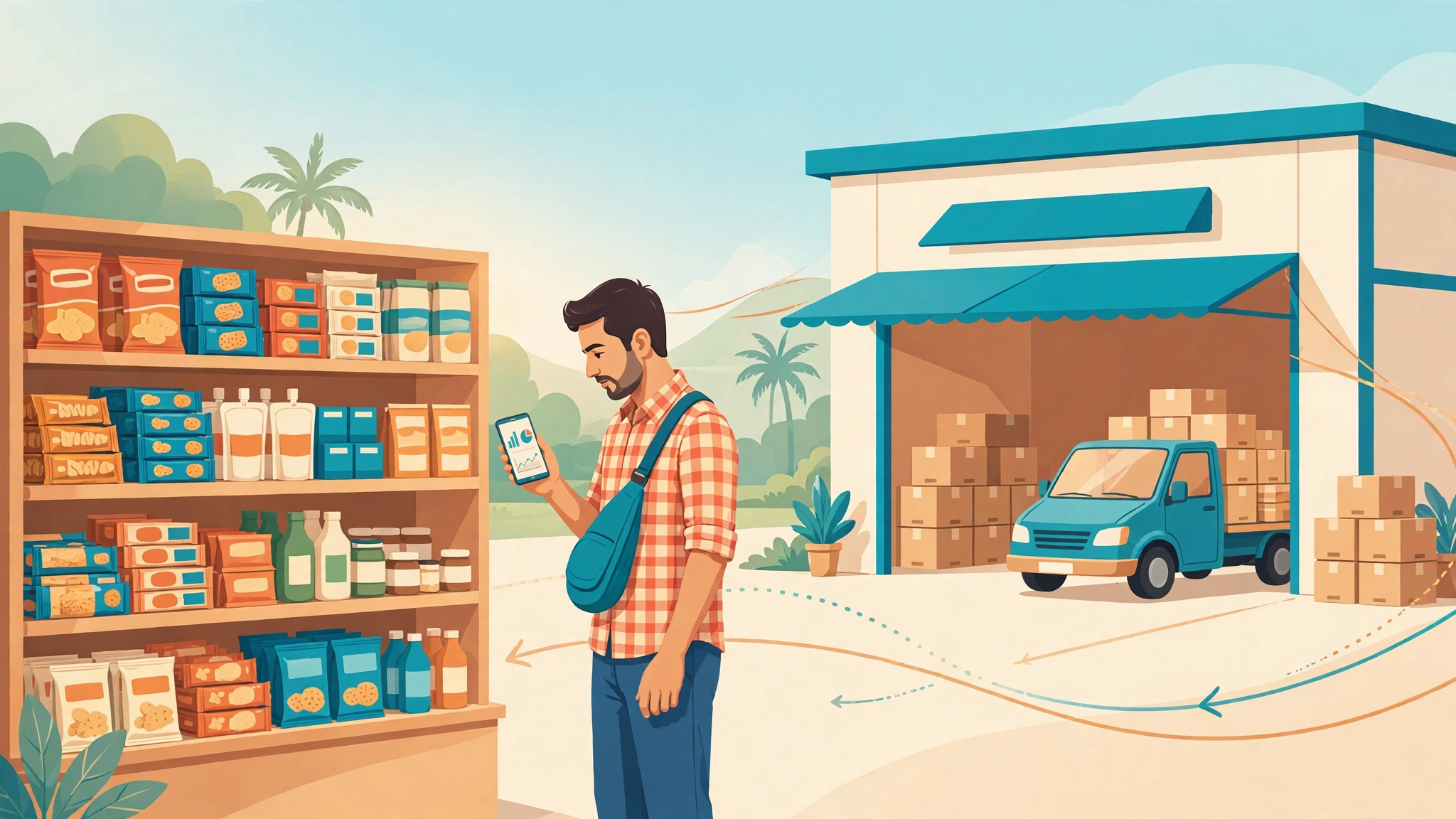
The gap nobody sees until month-end
Here's a scene every FMCG distributor in India knows well. Your godown dispatched ₹40 lakh of stock last month; primary sales look great on paper. Then your principal calls: retail offtake in your territory is flat, two SKUs are overstocked, and a competitor's product sits on shelves your salesman swears he visits weekly. The stock left your godown — but did it reach the shops?
That question is exactly what secondary sales tracking software answers. If you're still running distribution on primary billing plus a WhatsApp group full of salesman screenshots, you're flying blind on the one number that matters: what sold at the retail counter.
India's FMCG market was worth about US$ 289 billion in 2025 and is projected to nearly reach US$ 643 billion by 2030, according to IBEF's FMCG industry analysis. The distributors who survive that growth aren't the ones with the biggest warehouses — they're the ones who know what's selling, where, and to whom.
First, what "secondary sales" actually means
Goods in FMCG move in three hops, each with a name:
- Primary sales: company → distributor. The manufacturer bills you, stock lands in your godown, and the company books revenue — the number your principal celebrates.
- Secondary sales: distributor → retailer. Your salesman takes orders on his beat, your van delivers to kirana stores and pharmacies — the number that shows real market demand.
- Tertiary sales: retailer → consumer. The hardest to see, and the truest measure of demand.
As FieldAssist's guide to the secondary sales process puts it, primary sales show how much the company supplied — secondary sales show how much the market actually consumed. A distributor can lift a truckload on the 28th and not push a single carton to retailers for three weeks. Primary looks heroic. Secondary tells the truth.
Secondary sales tracking software records that second hop — every order, bill, outlet and beat — and turns it into reports you can act on the same day, instead of discovering problems at the next principal review meeting.
Why primary-only numbers lie to you
Primary sales are easy to inflate, and everyone in the chain knows it. Under month-end target pressure, the simplest lever is pushing excess stock into the distributor network. The distributor takes it — refusing strains the relationship, and there's usually a scheme attached. The stock sits in the godown, the company reports growth, and three weeks later the expiry clock starts ticking.
We've seen it repeat across Rajasthan and beyond: a strong primary month, then a flood of returns, damage claims and "slow-moving stock" requests. The principal blames the distributor's execution, the distributor blames weak demand, and neither side has the data to prove anything — because nobody tracked what actually moved from godown to shop.
The six leaks secondary sales tracking plugs
Revenue leakage in distribution is rarely one big theft. It's six small holes, each draining a little every day:
1. Scheme leakage
"Buy 12, get 1 free" sounds simple until your salesman is applying it from memory across forty SKUs with schemes that change every month. Some retailers get the free goods twice. Some never get them and stop ordering. When schemes are configured as masters and applied automatically at billing, with the cost reported by company, brand and period, the leakage stops being a mystery. Busy's FMCG guide makes the same point well: schemes, claims and near-expiry need to be visible daily, not discovered at year-end reconciliation.
2. Expiry and damage write-offs
FMCG expiry is fast and unforgiving — a carton of biscuits doesn't wait for your month-end review. Without batch and expiry tracking at the secondary level, slow-moving stock hides in your godown until it's unsaleable, and the damage claim window has already closed. FEFO issue (first-expiry-first-out), near-expiry alerts and a separate damage godown turn write-offs into a weekly action list: rotate it, push it through a scheme, or return it inside the window.
3. Unclaimed company claims
Scheme reimbursement, damage, expiry, price protection, display claims — each needs invoice-level evidence, raised inside a window. Distributors who track claims manually leave real money on the table every year; those who accumulate claims per company, with invoice and batch detail, recover it. Most owners underestimate this leak, because unclaimed money never shows up as a loss. It just never arrives.
4. Retailer credit that quietly stretches
Retail credit is small per bill and enormous in aggregate. Fifteen days becomes forty and nobody notices, because the outstanding is spread across six hundred shops. Bill-by-bill ageing by beat and salesman, with a credit limit that warns — or blocks — at billing time, keeps this in check. Your salesman should know a shop's outstanding before he books the next order, not after the goods are on the van.
5. Skipped beats and dead outlets
This one is usually the biggest leak of all, and the hardest to see without data. A beat has 80 outlets; your salesman visits 55 and bills 40. The other 25 either stopped buying or were never visited — and on paper, the beat still "covered" its target because the 40 active shops ordered more. Outlet coverage and non-buying-retailer reports show you exactly which shops went quiet and when. Often a shop stopped buying because of one bad experience — a missed delivery, a wrong bill — and a single visit wins it back.
6. Wrong replenishment and dead stock
Without secondary data, your purchase orders are guesses based on last month's primary lifting. With it, you can see which SKUs actually move in which territory and order accordingly — slow movers stop getting re-ordered, fast movers stop stocking out on the 20th, and your working capital stops sitting on shelves as dead stock.
What good software captures every single day
A tracking system is only as good as the data it captures at the counter. Check that the software records all of this without extra work from your salesman:
- Beat, route and salesman on every bill — so every rupee of secondary sales can be traced to a person and a place.
- Outlet-wise orders — which shop ordered what, when, and whether it paid.
- Schemes applied at billing — no memory, no manual maths, no double free-goods.
- Batch and expiry on every transaction — so FEFO and near-expiry reports are real, not estimates.
- Credit limit check before approval — the order gets flagged or blocked if the shop is over its limit.
- GPS visit proof — the beat plan says the shop was visited; the log proves it.
- Van sales reconciliation — stock issued in the morning, billed through the day, reconciled on return.
- WhatsApp orders that land structured — shopkeepers already order on WhatsApp; those orders should land in the system, not stay as chat screenshots. Our guide to POS billing at the retail counter explains why structured billing matters at the shop level too.
If a tool needs your salesman to fill forms at the end of the day, it won't survive a real beat. The capture has to happen inside the order itself.
Four reports worth reading every morning
Fifty reports are worse than none. Four are enough to run a distribution business honestly:
1. Primary vs secondary gap, by brand. What you lifted vs what you sold to retailers. A widening gap means stock is piling up in your godown — deal with it now, not at the principal's quarterly review.
2. Outlet coverage and non-buying outlets. Which shops didn't buy this week, and which haven't bought in 30 days? That's tomorrow's visit list, written by the data.
3. Scheme cost vs claim recovered. What you spent on schemes vs what actually came back as claims. If the gap is growing, your claim process is broken.
4. Ageing by beat and salesman. Who owes what, since when, and which salesman owns the follow-up. Collection stops being a general complaint and becomes a named list.
Buying checklist: picking software for an Indian distributor
Most DMS tools look similar in a demo. The differences show up in week three, on a beat with patchy network and a salesman who types in Hindi. Ask these before you sign:
- Does it work offline? Your salesman will lose signal between towns. Orders taken offline must sync automatically when he's back in range.
- Is it usable in Hindi? If the field team can't read it comfortably, they'll go back to WhatsApp within a week.
- Does it talk to Tally and handle GST properly? E-invoice, e-way bill, GSTR-1 and 3B should come off the same books — no re-entering invoices into Tally every evening.
- Can shopkeepers order on WhatsApp? That's where the orders already are. The tool should meet them there instead of asking them to learn a new app.
- What's the real cost? Per-salesman pricing, setup charges, training — get the full number, not the headline rate. And check go-live time: one to two weeks is reasonable; three months means the tool wasn't built for your size.
- Who trains your team? A login link and a PDF manual will sit unused. Look for onboarding that uses your actual data and your actual beats.
And don't compare tools by monthly fee alone. A system that recovers a fraction of your unclaimed schemes or cuts one expiry write-off a quarter usually pays for itself several times over. Measure it against the leaks, not the subscription.
Where RetailLine OMS fits
This is the problem our own product was built for. RetailLine OMS is distribution and order management software for Indian field sales teams — offline order booking, shopkeeper ledgers with credit limits, outstanding tracking, beat planning with GPS visit logs, and dispatch visibility from packing to delivery.
The secondary-sales angle is the point: every order carries its beat, route, salesman and outlet, so the gap, coverage and ageing reports are live data, not month-end archaeology. Shopkeepers can also order over WhatsApp and have it land structured in the system — that's how half your orders already arrive. If you're running distribution on spreadsheets and screenshots, it's worth a demo on your own data. Most distributors go live in one to two weeks.
The same discipline applies to the rest of your stack: proper inventory management software keeps the godown honest, and clean billing software for small distributors keeps the books honest. Secondary sales tracking is the layer that connects the two.
The bottom line
Primary sales tell you what you bought. Secondary sales tell you what your market actually wanted. Any distributor who has watched a godown full of stock and a territory full of empty shelves already knows which number matters — the only question is whether you're tracking it while there's still time to act.
Start small: pick one brand, one territory, and track secondary sales properly for thirty days. Compare it against your primary lifting. The gap you find will tell you more about your business than a year of month-end meetings — and exactly where the leaks are.
Frequently Asked Questions
What is secondary sales tracking software?
It records the movement of goods from distributor to retailer — every order, bill, outlet and beat — and turns that data into live reports on coverage, stock and collections. Unlike primary billing, which only shows what the company shipped to the distributor, secondary tracking shows what the market actually absorbed. For FMCG, pharma and general trade, it is the layer that exposes leakage, dead stock and skipped outlets before they become losses.
What is the difference between primary and secondary sales?
Primary sales are company to distributor: the manufacturer bills stock into the distributor's godown and books revenue. Secondary sales are distributor to retailer: the salesman's beat orders and van deliveries to kirana stores and pharmacies. Tertiary sales are retailer to consumer. Primary shows what was supplied; secondary shows what the market actually consumed — which is why a strong primary month can hide flat retail demand.
How does secondary sales tracking reduce revenue leakage?
It plugs the six usual leaks: scheme leakage, because schemes are applied automatically at billing instead of from memory; expiry and damage write-offs, through batch and FEFO tracking; unclaimed company claims, with invoice-level evidence per company; stretched retailer credit, with limits checked before approval; skipped beats and dead outlets, shown by coverage reports; and wrong replenishment, with orders based on real sell-through instead of last month's lifting.
Can a small distributor afford secondary sales tracking software?
Yes. Most systems built for Indian distributors are priced per salesman and go live in one to two weeks, with offline order booking and Hindi interfaces. The right comparison is not the monthly fee but the leaks: recovering a fraction of unclaimed schemes or avoiding one expiry write-off a quarter usually covers the subscription several times over.
Does secondary sales tracking replace Tally or my billing software?
No, it sits alongside them. Tally remains your accounting book; the tracking system captures the field layer Tally never sees — beats, outlet-wise orders, schemes, GPS visit logs and van sales. The two should integrate, so e-invoices, e-way bills and GST returns come off the same books without re-entering invoices every evening.