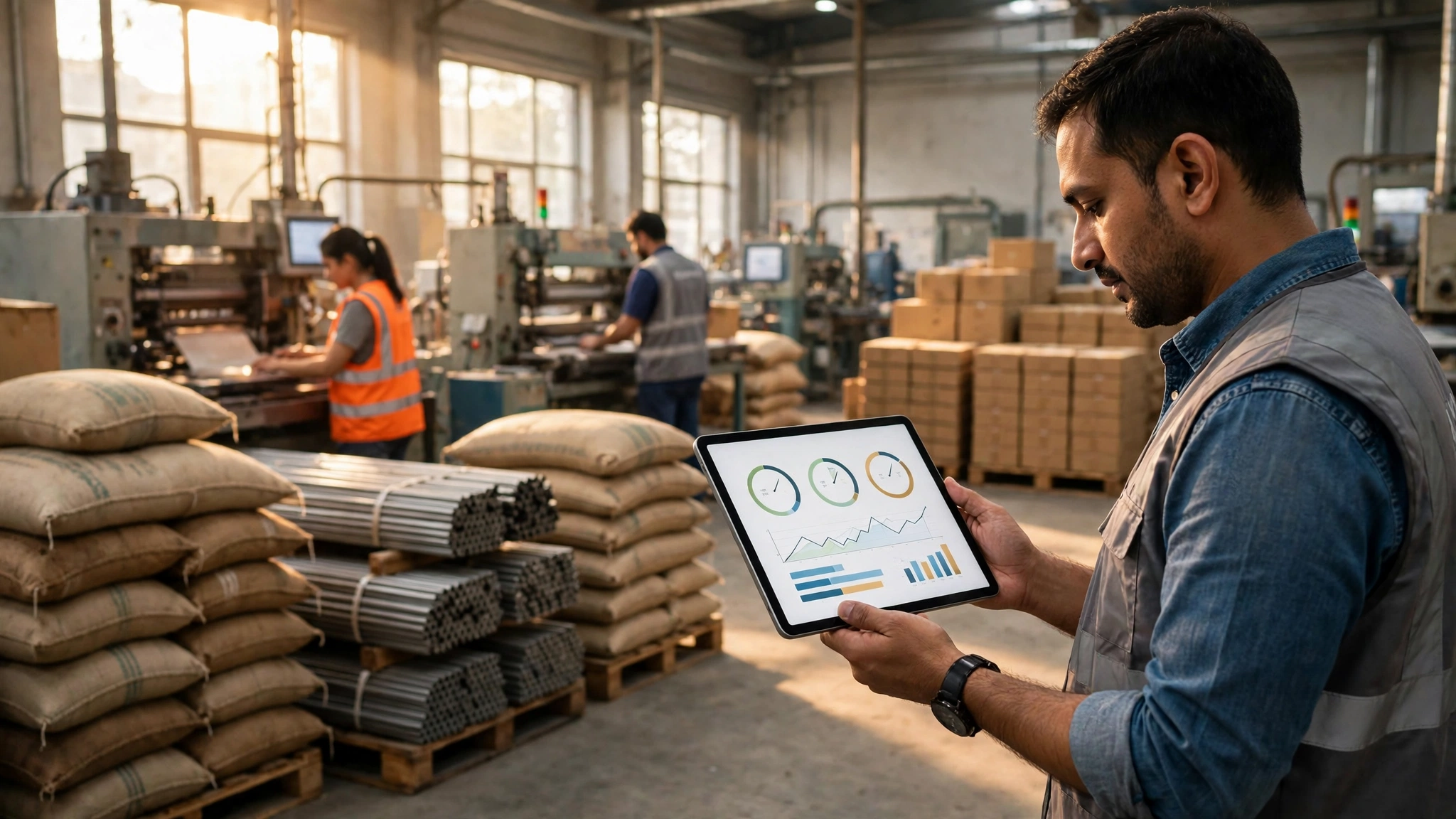
Walk into a small factory in Jaipur, Bhiwadi or Ludhiana and you'll see the same scene. The owner knows every machine by its sound. The supervisor carries the day's plan in his head. The storekeeper has a register for raw material, and the accountant has Tally open in the office.
And honestly? It works.
Until the day it doesn't.
A big order lands and nobody can say whether the raw material is actually in stock. A customer rings about a delayed dispatch and gets three different answers from three different people. I've seen that exact mess more than once — and it's never a people problem. It's an information problem.
That gap, between what the owner believes is happening and what's actually happening, is what an ERP closes. For a small manufacturer, the real question was never "is ERP good?" It's simpler than that: will it pay for itself in my factory?
What follows is eight benefits, each tied to a real cost or a real leak. Judge them against your own factory, not against a brochure.
First, what ERP actually does in a small factory
ERP — enterprise resource planning — is software that ties a business's day-to-day work together: accounting, purchasing, inventory, production, sales and dispatch, all running on one shared set of records. Oracle's definition of ERP puts it simply: by collecting shared transactional data from multiple sources, ERP systems eliminate data duplication and give the whole business a single source of truth.
In a factory, that means the sales order, the production order, the material issue, the dispatch and the invoice are all the same story, told once. Not five versions in five registers.
Small factories don't usually suffer from a lack of effort. They suffer from disconnected information. Our guide to ERP software for small businesses in India covers the wider picture; here we'll stay on the factory floor, where the money is actually won or lost.
The stock on the shelf vs the stock in the register
Ask most small manufacturers how much raw material they hold and the honest answer is "roughly". Stock lives in three places — the storekeeper's register, the accountant's books and the actual shelves — and the three rarely agree.
So you get the classic double loss: production stops because a component ran out, while cash sits locked up in slow-moving material nobody ordered on purpose.
An ERP tracks raw material, work-in-progress and finished goods in real time, with low-stock alerts before a shortage stops the line. Every material issue gets recorded against a production order, so the stock figure stops being an estimate and becomes a fact. And for a factory buying steel, plastic granules, fabric or packaging in bulk, even a modest cut in overstocking frees up working capital that's just been sitting idle on a shelf.
The plan in the supervisor's head
In a lot of small units, the production plan is a whiteboard, a WhatsApp group and the supervisor's experience. At 20 orders a month, that works fine.
At 60, it cracks.
Jobs start without anyone checking material. One machine sits idle while another is overloaded. And delays only surface after the dispatch date has already passed.
ERP brings structure: bills of materials (BOMs), production orders and planned-vs-actual tracking. A BOM says what goes into each item, a production order says what to make and by when, and the system shows whether the job is on track while there's still time to fix it. As Softengine's guide to SAP Business One for manufacturing notes, this connected flow gives small and midsize manufacturers control without the complexity of a large enterprise system.
The orders that quietly lose money
Most small manufacturers price by feel: material cost plus a margin they've used for years. But the real cost of an order includes machine time, labour, power, rework — and the odd rush purchase at a premium when material ran short.
Without job-wise costing, a factory can be busy all month and still not know which orders made money and which ones quietly lost it.
That's a scary place to be.
Recording material, labour and overheads against each production order gives you the true cost of every batch. That changes pricing straight away: you stop under-pricing the complex, low-volume jobs that eat machine hours, and you can quote confidently on the jobs you're genuinely good at.
The dispatch date that was never a plan
Nothing damages a small manufacturer faster than a missed delivery. A distributor who planned a launch around your dispatch date won't wait twice — they'll move the next order to your competitor.
Yet in a factory run on registers and memory, the dispatch date is more of a hope than a plan.
When sales orders, production status and finished stock sit in one system, the owner can see — before promising a date — whether material is available, whether the machine has capacity and whether the order is on schedule.
For B2B buyers, on-time delivery is the main reason they reorder. Full stop.
The leaks nobody sees
Scrap and rework are the quietest leaks in a factory. A batch rejected by a customer. A cutting plan that wastes material. A machine setting that drifts for a week before anyone notices. Each one looks small on its own — and adds up to a serious number over a year.
ERP helps in two ways. First, digital quality records — inspection results, rejection reasons, rework quantities — turn "we have a quality problem" into "this supplier's material fails twice as often". Second, once the data exists, the fixes are obvious.
You can't fix what you only suspect. You can fix what you can measure.
The month-end GST panic
For Indian manufacturers, compliance isn't optional paperwork. E-invoicing is mandatory for GST-registered businesses whose aggregate turnover exceeded ₹5 crore in any preceding financial year since FY 2017-18, under CBIC Notification No. 10/2023-Central Tax, and invoices issued without a valid IRN are invalid — which can also put the buyer's input tax credit at risk, as Legal Suvidha's guide to the ₹5 crore e-invoicing threshold explains in detail.
An ERP keeps purchase, production and dispatch records in sync with accounting, so the invoice, e-way bill and GST return all draw from the same data instead of being re-typed three times. That cuts month-end reconciliation from days to hours and removes the most common filing error — the same figure entered differently twice.
If your turnover is anywhere near ₹5 crore, this alone justifies moving off disconnected tools.
Two numbers that can't both be right
Ask the accountant what the month's profit was, then ask the production head what the month's output was. In many factories you'll get two numbers that can't both be right.
Tally knows the money; the shop floor knows the material; nobody reconciles the two until the annual audit — or a bank asks for stock statements.
And yes, owners always ask whether ERP replaces Tally. The honest answer depends on what you need: Tally is excellent accounting software, but it isn't a production system. Our comparison of Tally vs ERP software works through the signs you've outgrown an accounting-only setup.
In an ERP, the stock statement, production report and profit figure all come from the same transactions, so the numbers agree by construction.
Growing without the chaos growing too
Every small manufacturer hits a size where the old way stops scaling: more orders, more staff, a second godown, maybe a second unit. The owner who once knew every order by heart now spends the whole day firefighting — chasing updates on WhatsApp and discovering problems only after they've cost money.
An ERP absorbs that growth. Adding a product line, a location or a few users means adding records to a system that already knows how the business works. Cloud ERP makes this practical for small factories — lower upfront cost, no server room, access from anywhere — and, as ManufApp's guide to ERP for small manufacturers points out, entry-level cloud pricing is now built for businesses just moving off spreadsheets; implementation time and training, not just the subscription, are the real costs to budget for.
Will it pay for itself? Do the maths first
Before talking to any vendor, spend one week writing down four numbers: production hours lost to stockouts, finished stock sitting unsold, orders dispatched late, and hours spent re-entering the same data in different registers. Then put a rupee value on each.
If the total is small, your current setup may genuinely be enough — and that's a fine answer. If it's large, you've got your payback case: compare it against the ERP's total cost, including implementation, training and data migration, not just the monthly subscription. The wider benefits of ERP software follow the same logic — the system pays when it removes a cost you're already paying.
What to get right before you buy
- Start with clean masters. Your item list, BOMs and opening stock have to be accurate before migration, or the ERP will just automate your existing mistakes.
- Pick one owner inside the factory. ERP projects fail when nobody owns them. One person — usually the production head — should be responsible for adoption, not the vendor.
- Roll out in phases. Inventory and production first, then purchasing, dispatch and reporting. Going live on everything at once usually means going live on nothing.
- Demo with your own data. Ask the vendor to demo with your actual BOMs and a real order. If the system can't handle your shop-floor reality in a demo, it won't handle it after you pay.
The bottom line
ERP isn't magic, and it isn't for every factory — a ten-person unit making one product for two customers may not need it yet. But the moment stockouts, late dispatches, unknown costs or GST reconciliation start eating your week, the question stops being "can we afford ERP?" and becomes "can we afford to keep running blind?"
Look at the eight benefits above and you'll spot one pattern: each one replaces a guess with a fact — what's in stock, what an order costs, whether a dispatch will happen, whether the GST return is right. In a small factory those facts are worth more than any feature list, because the owner makes every decision on them.
If you're weighing the move, our team builds custom ERP software for manufacturers sized to small and midsize operations — or run your own numbers first using the checklist above. Either way, decide on the leaks, not on the brochure.
Frequently Asked Questions
How much does ERP cost for a small manufacturing business in India?
There is no single price — it depends on users, modules and whether you choose cloud or on-premise. Entry-level cloud ERP is priced per user per month and suits businesses just moving off spreadsheets, while enterprise systems like SAP or Oracle cost far more and are usually overkill for a small factory. Always ask for a quote that includes implementation, training and data migration, not just the subscription — those one-time costs decide the real payback time.
Is ERP worth it for a factory with fewer than 50 employees?
It can be, if the factory's problems are the ones ERP solves: stockouts, late dispatches, unknown order costs or painful GST reconciliation. A ten-person unit making one product for two steady customers may not need it yet. The test is simple: add up what stockouts, rework, late deliveries and duplicate data entry cost you in a month, and compare that with the ERP's total monthly cost.
Can ERP replace Tally in a manufacturing business?
ERP does not have to replace Tally — many small manufacturers keep Tally for accounting and use ERP for production, inventory and dispatch, with the two systems connected. Tally is excellent accounting software but it is not a production system: it does not manage bills of materials, production orders or shop-floor tracking. If your accountant lives in Tally, make sure the ERP you choose integrates with it.
How long does it take to implement ERP in a small factory?
Smaller manufacturers usually roll out faster than large enterprises because there is less data and fewer departments to migrate, but the timeline still depends on data readiness and how many modules you switch on at once. A phased rollout — inventory and production first, then purchasing, dispatch and reporting — keeps the factory running while the system beds in. The biggest delays usually come from dirty master data, not from the software itself.
Does ERP help with GST compliance and e-invoicing?
Yes. An ERP keeps purchase, production and dispatch records in sync with accounting, so the invoice, e-way bill and GST return all draw from the same data instead of being re-typed three times. That matters because e-invoicing is mandatory for GST-registered businesses whose aggregate turnover exceeded ₹5 crore in any preceding financial year since FY 2017-18, and invoices without a valid IRN are invalid.